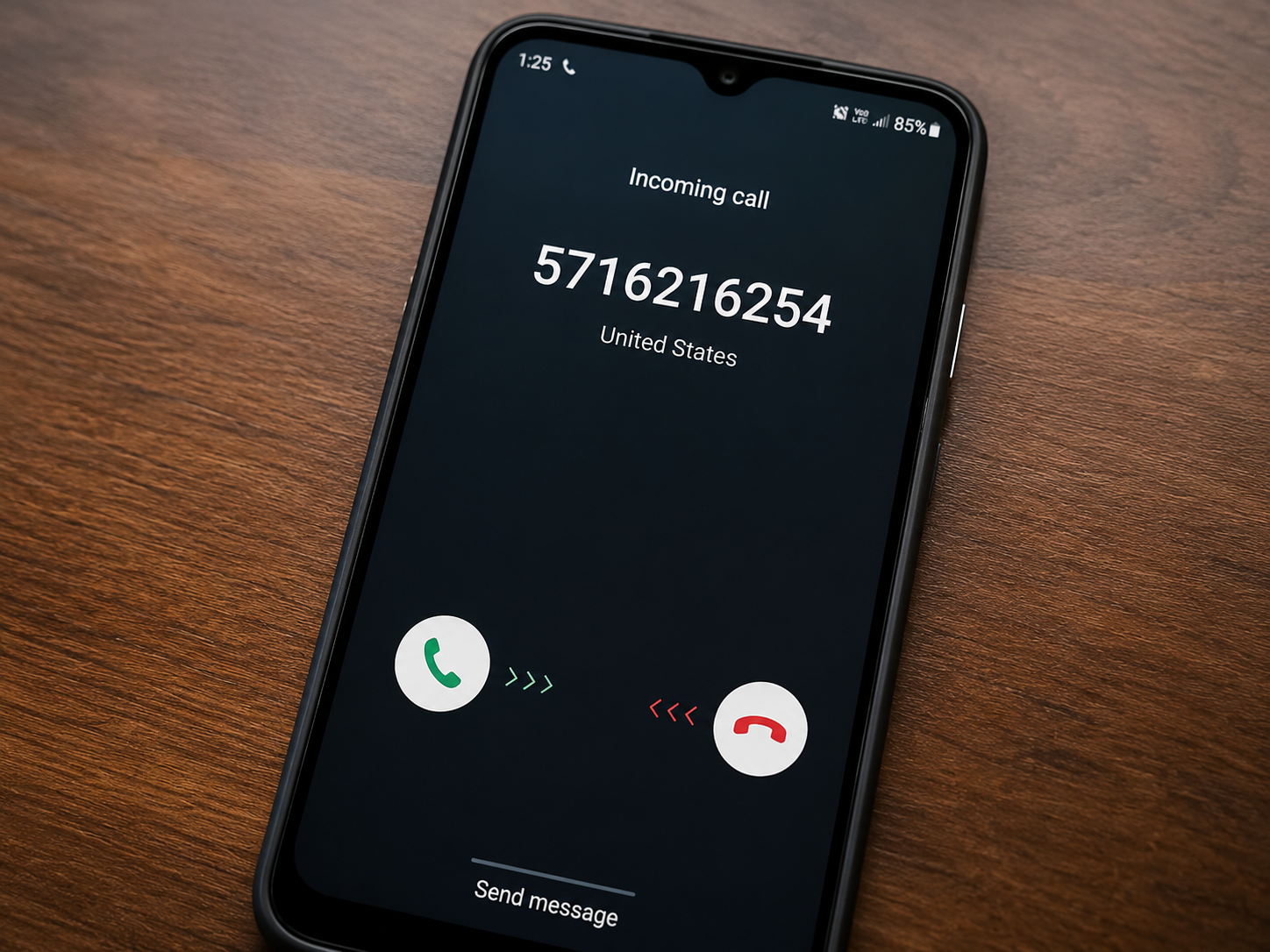
The keyword 5716216254 may look like nothing more than a random sequence of ten digits, but numbers like this often attract attention when they appear in a missed call, text message, online record, account notification, or other digital context. When people search for a number without any additional information, their main question is usually simple: what is this number, and should I be concerned?
In this case, 5716216254 can be formatted as 571-621-6254, making it look like a U.S. telephone number. However, a number alone does not provide enough reliable information to identify its owner, purpose, or legitimacy. It is important not to assume that every unfamiliar number belongs to a scammer, a business, or a specific person.
Online discussions around 5716216254 provide different interpretations, with some pages treating it as an unknown phone number and others discussing it as a possible digital identifier. These inconsistent explanations are a good reason to focus on the context in which the number appeared rather than making unsupported claims about its exact identity.
What Is 5716216254?
The most obvious interpretation of 5716216254 is that it is a ten-digit phone number. In the United States and other countries that use the North American Numbering Plan, ten-digit numbers commonly include a three-digit area code followed by a seven-digit local number.
If the number appeared on your phone screen as 571-621-6254, it may simply have been the caller ID displayed during an incoming call. However, caller ID information should not automatically be treated as proof of who actually placed the call.
Another possibility is that the number appeared in a completely different context. Numerical sequences can be used as reference numbers, support tickets, database records, transaction identifiers, tracking codes, or internal account references. The meaning of 5716216254 therefore depends heavily on where you saw it.
Why Are People Searching for 5716216254?

One of the most common reasons people search a number like 5716216254 is after receiving an unexpected call. Unknown calls naturally create curiosity, especially when the caller does not leave a voicemail or repeatedly contacts the same person.
Another reason may be an unexpected text message. A number could appear in an SMS notification, automated message, account alert, or promotional communication. Before reacting, it is helpful to consider whether you recently interacted with a company, service provider, delivery platform, bank, or online account that may have a legitimate reason to contact you.
People may also encounter 5716216254 while browsing the internet. Because numerical keywords can be copied, indexed, or mentioned across different websites, the same sequence may appear in articles and search results without referring to one clearly established source. This is why context matters more than the number by itself.
Could 5716216254 Be a Phone Number?
Yes, 5716216254 has the structure of a ten-digit telephone number. If written with standard formatting, it would appear as 571-621-6254.
However, recognizing a number as a phone number does not reveal who owns it. A telephone number may belong to an individual, business, customer service operation, automated calling system, virtual phone service, or another type of communication provider.
There is also an important complication: caller ID spoofing. The U.S. Federal Trade Commission warns that scammers can use technology to make a fake name or number appear on caller ID. This means the number visible on your screen may not necessarily be the actual number from which the caller is operating.
Is 5716216254 a Scam Number?
There is not enough reliable evidence to label 5716216254 itself as a scam number simply because it is unfamiliar. An unknown number is not automatically dangerous, and publishing an unsupported accusation against a number or its possible owner would be misleading.
What matters is the behavior of the person or automated system contacting you. If the caller creates panic, demands immediate action, requests sensitive information, or pressures you to send money, those behaviors are more important warning signs than the number alone.
The FTC advises consumers to be particularly cautious about unexpected calls involving threats, urgent payment demands, prize claims, account problems, or requests for sensitive information. A caller ID number, even if it looks local or familiar, should not be considered proof that the caller is legitimate.
How Caller ID Spoofing Can Cause Confusion
Caller ID spoofing occurs when someone manipulates the information displayed on the recipient’s phone. A call may appear to come from a local number, a business, or another familiar source even when the actual caller is somewhere else.
This creates an important problem when researching 5716216254. Even if a person finds information about the number through a reverse search, that information may not necessarily identify the person who actually made the suspicious call.
Spoofing can also affect legitimate phone numbers belonging to innocent people or businesses. For this reason, receiving a suspicious call that displays 5716216254 does not automatically mean that the legitimate owner of that number is responsible for the call.
What Should You Do If 5716216254 Calls You?
The first step is to remain calm. If you do not recognize the number and the call seems unexpected, you are not required to answer immediately or return the call.
If the caller leaves a voicemail, listen carefully to what they say. A genuine caller may provide useful information such as their name, organization, reason for calling, and a safe way to verify their identity independently.
If someone claims to represent your bank, government agency, delivery company, or another organization, do not rely solely on the number provided by the caller. The FTC recommends contacting the organization independently through its official app, website, recent statement, or another verified contact method.
One of the most important rules for handling unexpected calls is to protect your personal information. A stranger calling from 5716216254, or any other unfamiliar number, should not receive sensitive details simply because they sound convincing.
Be cautious if someone asks for passwords, banking details, Social Security information, account verification codes, or other confidential data. Legitimate organizations generally have secure procedures for handling sensitive information.
Verification codes deserve special attention. A code sent to your phone can sometimes be used to access or confirm activity on an account. The FTC specifically advises consumers to keep account verification codes private and not share them with unexpected callers.
How to Check an Unknown Number Safely
A reverse phone search may provide additional information about an unfamiliar number, but the results should be treated carefully. Online databases can contain outdated, incomplete, or incorrect information.
You can also search the exact number in quotation marks to see whether people have reported receiving similar calls. However, a lack of reports does not prove that a call is safe, and online complaints do not always prove who was actually behind the call.
The safest approach is to combine available information with the context of the communication. Ask yourself whether you were expecting the call, whether the caller provided verifiable details, and whether their behavior included pressure or suspicious requests.
Common Warning Signs to Watch For
Urgency is one of the biggest warning signs. A caller who says you must act immediately may be trying to prevent you from taking time to verify the situation.
Another warning sign is an unusual payment request. The FTC warns that scammers may demand payment through methods that are difficult to reverse, including gift cards, wire transfers, cryptocurrency, or certain payment applications.
Threats should also be taken seriously as a warning sign, but not necessarily as proof that the threat itself is real. A caller claiming that you will be arrested, lose benefits, or face immediate consequences may be using fear to pressure you into acting without verification.
Should You Call 5716216254 Back?
Calling an unfamiliar number back is not always necessary. If the call was important, the caller may leave a voicemail, send a message, or contact you again through a legitimate and verifiable channel.
If the caller claimed to represent a specific organization, it is generally better to find that organization’s official contact information independently rather than calling back solely because the number appeared on your caller ID.
For suspicious robocalls, the FTC advises consumers to hang up rather than pressing buttons to speak with an operator or supposedly remove themselves from a calling list, as interacting may sometimes lead to additional unwanted calls.
How to Block 5716216254
If you repeatedly receive unwanted calls from 5716216254, most modern smartphones provide a simple option to block the number through the call history or phone settings.
Blocking a number can reduce repeated contact from that specific caller ID. However, blocking one number cannot prevent future calls if a caller uses spoofing technology or changes numbers.
Call-blocking and call-labeling services may provide additional protection. The FTC notes that blocking tools can be available through smartphone settings, mobile carriers, apps, and other communication services.
Should You Report a Suspicious Call?
Reporting suspicious calls can help authorities and service providers identify patterns. If you received an unwanted call but did not lose money, the FTC provides a process for reporting unwanted calls.
If you lost money or believe you have information about fraud, a more detailed fraud report may be appropriate. When making a report, useful information can include the number shown on caller ID, the date and time of the call, and any number the caller asked you to contact.
It is worth remembering that a reported caller ID number may itself have been spoofed. Nevertheless, reports can still help authorities analyze broader calling patterns and investigate illegal activity.
Could 5716216254 Be a Reference Number Instead?
Although the number resembles a telephone number, 5716216254 could potentially appear as another type of identifier depending on the situation.
Businesses and digital systems use long numerical sequences for order numbers, support cases, transaction records, internal databases, and tracking purposes. A number that seems meaningless on its own may become understandable when connected with the website, application, email, or document where it appeared.
This is another reason why users should avoid assuming that 5716216254 has one universal meaning. The number’s context is the key to understanding it.
Why Context Is More Important Than the Number
Imagine seeing 5716216254 in three different places. If it appears in your missed-call list, the telephone-number explanation becomes the most likely interpretation.
If the same number appears in an order confirmation, it may instead be an order or reference ID. If it appears inside a database or software system, it could function as an internal identifier.
The digits themselves do not explain their purpose. Looking at the surrounding information is usually the fastest way to understand what the number represents.
Final Thoughts
The keyword 5716216254 is best approached with caution and context. It can be written as 571-621-6254, giving it the appearance of a U.S.-style telephone number, but the number alone is not enough to reliably identify a caller or determine whether the communication is legitimate.
If you received a call from 5716216254, avoid making assumptions based only on caller ID. Look for a voicemail, verify any claimed organization independently, and never share personal, financial, or account security information with an unexpected caller.
The safest approach is simple: stay calm, do not respond to pressure, verify unexpected claims through official channels, block repeated unwanted calls when necessary, and report suspected fraud. Since caller ID information can be spoofed, the behavior and requests of the caller are far more important than the digits displayed on your phone screen.
You May Read More
South Africa National Cricket Team vs India National Cricket Team Match Scorecard












One Comment